
 Apple Music Profile
 YouTube Channel
 RSS Feed
 Play Play
 Murph
Murph Yer Stack
 Block Party Weekend
 30 Most Recent RSS Feed
Managing Files
UPDATED: Drop to Add and Give Info v2.0
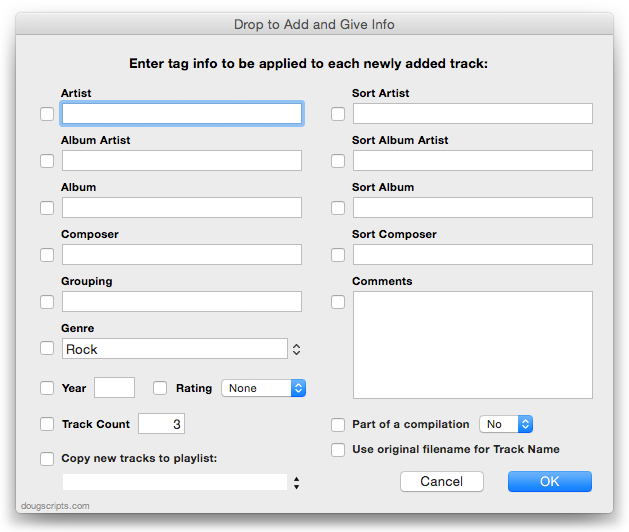
Drop to Add and Give Info v2.0 is a Cocoa-AppleScript Droplet. Drag audio files to its icon in the Finder (or Finder bar) and a multi-edit window will allow you to set many common tags before the script adds the files to iTunes, after which your tag info will be applied to the new tracks. Saves trips to iTunes when batch-adding files. Additionally, tracks can be copied to a new or existing playlist.
For OS X 10.6 or 10.7 only. The previous universal version is available via direct download at the script's entry page.
Bevy of Updates
I've just updated the last batch of scripts most recently posted to account for iTunes' full-screen mode in Lion. My good friend Kirk McElhearn is a devoted iTunes-in-full-screen-mode user and he describes the situation so elegantly that you might as well read about it at his site.
The latest scripts re-posted with quick updates are: Super Remove Dead Tracks v3.1, Remove n Characters From Front or Back v4.1, Save Album Art to Album Folder v4.1, Save Album Art as folder.jpg v2.1, and Re-Apply Downsized Artwork v2.1.
So, if you picked any of those up in the past couple of days, you may want to re-up to the latest versions.
NEW: Drop to Add and Give Info
I often have to add files to iTunes that I've received as mail, iChat, or Skype attachments or from other disparate sources. They're usually audio files that friends or colleagues have generated and aren't necessarily song files. They usually don't have any ID3 Tag info other than the file name/track name. I just drag 'em to iTunes, select a batch after they're added and multi-edit their tags. But somehow this workflow doesn't feel right to me. If I were ripping a CD, I'd enter the tags in the CD tracks before importing. Likewise, when I use PDF Adder I'm obliged to enter any tag info first.
But when I'm importing the files from the Finder I can only edit the tag info after the files are added. Thus, I have to find them in iTunes, select them, press Command-I to get the multi-edit window, and then I can start tag editing. Doesn't feel right.
So I put together a droplet called Drop to Add and Give Info that launches a GUI for multi-editing after you drop files on it but before the files are added to iTunes:
All Those Audio Formats
Via Lifehacker, this How-To Geek article is a great primer on the differences among digital audio formats.
Get a Track Reference from a File Path
Correspondent Wayne B. recently wondered if there is a way to get a reference to a track in iTunes based on its file path. Well, unfortunately, you can't do something like this:
tell application "iTunes"
	set trackRef  to (get some file track of library playlist 1 whose location is "some/file/path.ext")
end tell
That will generate an error. But you can trick iTunes into giving you the track reference by using the add command--if you are certain the file is already in iTunes' database. When you add the file iTunes will check its database for the the corresponding library track for you and if it exists will give up the reference--and it won't re-add it:
set theFile to choose file
-- or however you get the file path

tell application "iTunes"
	try
		set trackRef to (add theFile as alias)
		tell trackRef
			log (get name)
			# and so on...
		end tell
	end try
end tell
But remember that if the file isn't already in iTunes' database then iTunes will add the file as a matter of course, which may not be what you want. So this trick may work best only when you know a file is currently in your library.
You will not want to use the open command instead of add, because open will compel iTunes to play the file in addition to any add-housekeeping.
UPDATED: PDF Adder v3.2
PDF Adder v3.2 is a collection of three scripts (an applet, a droplet and a PDF Services workflow) that assist with adding and tagging PDFs in iTunes.
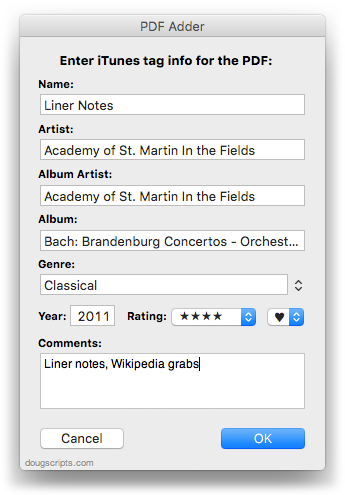
The latest version includes fixes to all three scripts, including a cancel loop bug and a misnamed bundle. I've also added Description to the tags you can apply. This is the PDF Services script in action, activated from the PDF popup in the Print Dialog:
I've written before on how the "Add as PDF to iTunes" workflow works great with Safari Reader and NetNewsWire.
UPDATED: Re-Locate Selected v1.2
Re-Locate Selected v1.2 really fixes the version check error at launch. With the hullaballoo over the weekend concerning the latest version of iTunes, I hurriedly posted v1.1 yesterday which did not completely resolve the issue.
NEW: Re-Locate Selected
Re-Locate Selected will re-locate the files of the selected iTunes tracks from their current location to a new user-chosen folder. iTunes will be updated with each track's new location and all of each track's meta-data will be preserved. There's also an option to remove the files from their original location.
UPDATED: Lossless to AAC Workflow v2.2
If you're one of the Correspondents who over the past couple of years have been suggesting I add AIFF-ability to Lossless to AAC Workflow, then the new v2.2 is for you.
These are two scripts that assist with importing/managing Apple Lossless or AIFF audio files and sending converted AAC copies to a mounted iPod set to "manually manage songs and videos". Yes, iTunes 9.1+ will auto-encode tracks to iPod, but only 128kbps AAC; these scripts enable to use your Custom AAC encoder settings.
NEW: Music Folder Files Not Added v2.0
Well, depending on your point of view, perhaps this is an update. Music Folder Files Not Added v2.0 is a Snow Leopard-only application (MFFNA v1.1 is still posted and will run on Tiger and Leopard) that will list the file paths of the files in your designated "iTunes Music" folder which are not in iTunes' library. Additionally, you can select a different parent folder and its contents will be compared to the iTunes library. You can then Add a selection of found files to iTunes or move them to the Trash.
This version was developed with Xcode using the new AppleScriptObjC framework and as such will only run on Snow Leopard.
